Saturday, March 10, 2012

Kony Capitalism

Has someone you love swallowed the Kony Kool Aid? If so, drag him to this site immediately and hold his face under it for a full 15 minutes.

If he does not respond, quickly remove his Kony bracelet, log onto this site and read the text aloud slowly and clearly, making sure he absorbs all of the facts.

If all else fails, you may have to physically pull his head out of his ass and insist that he do some serious research and think for himself before giving money to a self-aggrandizing charlatan. Then direct him to a list of charities that are actually in Central Africa helping people.

(IMPORTANT: if the victim is a woman, please change the pronouns accordingly.)

Thursday, March 8, 2012

The Greenbax

Based on Dr. Seuss' original story, The Lorax. With apologies to Dr. Seuss. ... For the movie. For the unethical marketing strategy. For the Truffula-Tree-Certified hypocrisy. For the whole stinking mess.

<><> <><>
"Dear Lord, is there
nothing I wouldn't
do for a buck?"

At the far end of town
where the Grickle-grass grows
and the wind smells slow-and-sour when it blows
and no birds ever sing excepting old crows …
is the School of the Lifted Greenbax.

Who owned the Greenbax?
And why should you care?
And why were they lifted and taken somewhere
from the far end of town where the Grickle-grass grows?
The old VanRoekel was just there.
Ask him. He’ll know.

"Now I’ll tell you,” he says, with his hair dapper gray,
“how the Greenbax got lifted and taken away …
It all started this year …
At The Lorax premiere…

Way back in the days when we all were still green
and our ear-backs were wet
and our hearts were still clean,
and songs like “Don Gato” rang out in the schools …
I came to this place to try bending some rules.

And I first saw the dupes!
The innocent dupes!
The bright shiny faces of the innocent dupes!
Row after row, and some gathered in groups.

And, raising those dupes I saw poor ma’s and pa’s
frisking about in their worn-out used cars
as they dropped off and picked up their gifted young stars.

But those kids! Those kids!
Those impressionable kids!
All my life I’d been searching
For kids just like this.
A “soft touch” on their folks
and adults of their ilk
will make us quite rich.
They’re so easy to milk.

In no time at all, Mazda partnered with us.
Then we gave a few bucks to a short guy named Gus
to dress like the Lorax (though at first he said “no!”).
And I sent him to school to rake in the dough.

“Children,” he said with a reddish-faced wheeze,
“I am the Lorax, I speak for small fees.
I speak for these fees to bamboozle the young.
And I’m asking you kids at the top of my lungs” –
He was loud ‘cause he needed the job to survive –
“Your folks have just GOT to take a test drive!”

“Look, Lorax,” I said. “There’s no need here to shout.
We’ve colluded with Mazda. We’ve worked it all out.
We’re being quite clever. This deal serves us all --
Disney and Mazda, and me most of all.

It's a ruse. It's a sham. It's a con. It's a trick.
We tell all the kids that their library’s sick.
To help it get better, all they need do
is to get mom or dad to take a test drive. Or two.

For each simple test drive (no need to make offers!)
Mazda pays a small fee which we stick in our coffers.
At ONE MILLION BUCKS (thanks to public largess)
We’ll dole out small bits through an undisclosed “process.”

              The Lorax said,
              “Sir, you are crazy with greed.
              There’s no school board on Earth
              that would let you proceed!”

But the very next minute I proved he was wrong.
For the kids in the school broke into a song.
“Now, get on that stage and start dolling out hugs
Or you’ll find yourself jobless and back selling drugs.”

The Lorax said nothing. Just gave me a glance …
Just gave me a very sad, sad backward glance …
As he lifted himself by the seat of his pants.
And I’ll never forget the grim look on his face
when he heisted himself and took leave of this place,
past the wide-eyed young children, he was paid to debase.

That wasn’t so long ago.
But each day since that day
I’ve sat here and worried
how the story would play.
But though we have blasted releases with charts
none in the media has torn us apart!
All of which tells me
This is only the start.


Sunday, February 12, 2012

Sorry about your dogma.

If you haven't heard
them yet, download some
Firesign Theatre. You
will thank me.
It happened so fast! It just darted out in front of my argument and--before I could take my foot off the gag--it got crushed by my conclusion.

I wasn't aiming for it. Really.

I know this may not comfort you now, but I want you to know that I did not single out your dogma. Heck, I don't care enough about anybody's dogma to aim for it. It's just that I love blasting through current events, shining the high beams on hypocrisy, BS, and general high-profile stupidity, and sometimes I ding a few of them.

The hate-mail affects me, of course, especially those emails thanking me for denting some other guy's dogma. Let me tell you, those comments bring me little joy. It's still joy. Just not a whole lot of it.

Recently, I've been accused of nicking left-leaning dogmas more often than right-leaning ones, and technically that's true (score to date -- Left jab: 30%, right hook: 16%, floating like a butterfly: 53%, nut-shot to al-Qaeda: 1%).

But that is not because of my political orientation. Quite candidly, I don't have a political orientation. To paraphrase Groucho Marx "I don't care to belong to any political party that would have me as a member."

But I do find that the dogmas coming at me from the extreme left are more inclined to try to stifle my free speech--and my free thought--than those from the right. (Always with the best of intentions, mind you.) While the knuckleheads on the far right are more interested in controlling my sexual orientation and my religious beliefs. And that pabulum is not even worth dignifying with a slap.

Before it happens again (and it will), let me explain the philosophical orientation of FlackOps by quoting Penn Jillette, the wisest person on the planet. "The difference between telling the truth as you see it, from your heart, with passion, and trying to win people over is--I guess the technical term would be an RCH, ..." (look it up) "... just the slightest possible difference. But to me, it's very important."

But Serius, I don't care
what dogma star you pray to.
 For two decades, my team and I launched clever PR campaigns to influence what people thought. And we were very good at it, winning far more hearts and minds than our competition. But lately, I've come to realize that the 20th century PR techniques we employed, while legitimate and effective, hewed too closely to Bernays' early 20th century definition of "propaganda."

So I shifted gears. Rather than trying to "win people over," I now advise my clients to tell the truth as they see it, from the heart, with passion.

And I use FlackOps to call shenanigans on the more blatantly dishonest old-school PR campaigns, (while offering some tips on how to achieve the same goals with more transparent means)--because the Internet is gonna impose transparency on us whether we want it to or not.

Along the way, I'm going to offend a lot of people. Including myself.

Saturday, February 4, 2012

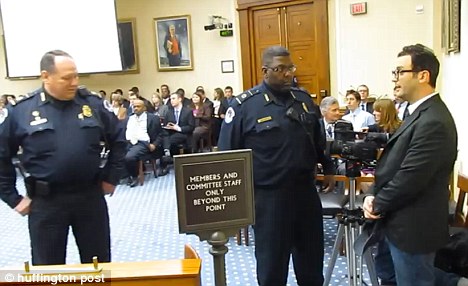
Gaslight: A flim-flam by Josh Fox


"Ok. In this scene, you will
cuff me and lead me out
of the hearing room. Let's see
if we can get it in one take."
Gaslight: To manipulate events and situations in order to make a person believe that he or she is crazy.

Congressman Andy Harris (R-MD) got gaslighted big time this week by Josh Fox, the Oscar-nominated "activist-director" of the documentary Gasland.

When Rep. Harris booted Fox from a congressional hearing on hydraulic fracturing—or fracking—he undoubtedly assumed that as Subcommittee Chairman he had both the authority and the duty to remove an uncredentialed anti-fracking activist from his hearing room.
But by the time he got back to his office, he must have wondered what he was thinking when he ordered the Capitol police to remove the torchbearer of the First Amendment of the U.S. Constitution from his hearing.
According to the HuffPost, MSNBC, the Twitter-sphere, hundreds of thousands of Facebookians, and Professional-Journalist-and-Free-Speech-Champion Fox himself, that is exactly what Harris did.
"They threw out John Boehner's promise of transparency in Congress in handcuffs with me yesterday. They threw out the First Amendment and they threw out the Constitution. And now they're paying for it," he said on Current TV. 
 
"Me? Uhhh ... just another
newshound, sir."
He told U.S. News and World Report that his near-martyrdom was "a civil rights violation and a human rights violation."  

(Being hounded by your government to the point of suicide is a human rights violation, Josh. Getting arrested for refusing an order to leave a Congressional hearing is not.) 

Ironically, Fox's bravura turn as "Joan-alist of Arc" is prima facie evidence that he is no journalist. Reporters expect to get thrown out of hearings that they're not allowed to be in. It's all part of the job.

It is also generally accepted that real journalists at least pretend to be objective in their pursuit of the truth. But it turns out that Fox isn't really all that fair and balanced after all.

In one of the most dramatic scenes in Gasland, Mike Markham lights his tap water on fire, which Fox said was the result of nearby fracking. But that wasn't true, according to the Colorado Department of Natural Resources. And Fox knew it wasn't.

In fact, Fox featured numerous claims about fracking in Gasland that were demonstrably false, despite having been presented impartial scientific research that debunked those claims prior to the film's completion.

Perhaps most damaging to Fox's journalistic integrity is the lengths he went to hide this exculpatory information from the public. 

Enter real journalist and documentary filmmaker Phelim McAleer. At a Gasland screening in Chicago, McAleer asked Fox if he was aware of reports of spigots spewing flames decades before the Markham in-sink-eration. He cited a 1976 report which attributed the flaming tap water phenomenon to naturally occurring methane build-up in the aquifers.

In a moment of uncomfortable candor, Fox called McAleer's bet and raised him with, "Well, I don't care about the report from 1976. There are reports from 1936 that people say they can light their water on fire in New York state. But that's no bearing on their situation, at all."

Armed with a 75-year-old study that he hadn't been aware of, McAleer went all in. "Most people watching your film would think that lighting your water started with fracking. You said yourself people lit their water long before fracking started, isn't that correct?"

"Yes, but it's not relevant," Fox said.

Documentary gold! But you can't find that nugget on Youtube or Vimeo. Fox's lawyers got it yanked off of those public forums. While not a human rights violation, that censorship certainly smacks of hypocrisy.

You can see the exchange at www.fightgaslandcensorship.com. But if you don't like going to the movies by yourself, you may want to watch it with a friend. To date, that site has only received 9,581 visitors (and at least a dozen of those visits were mine as I transcribed the exchange). Compare that to the HuffPost article about Fox's arrest that has garnered 22,000 comments, 31,500 Facebook "shares," and 109,000 Facebook "likes" just in the past three days.

"No, today I'm an activist.
No apology necessary.
Common mistake."
This whole fracking mess offers many useful PR lessons, not the least of which is "always consider the optics and the long-term ramifications of your actions, especially when you're on camera." 

It also reignites the debate over what it means to be a credentialed "journalist." (And it's a debate worth having now that the Internet has altered the way we communicate.) As McAleer showed us, some documentary filmmakers actually are journalists. And as Fox showed us, some of them just play that role when it suits them.

UPDATE: Lost in all the gnashing of teeth over trampled First Amendment rights is the fact that Fox apparently orchestrated an elaborate hoax to get his film crews (plural) into the hearing. And since the hearing was carried live over CSPAN and was streaming over the Subcommittee's website, it seems likely that Activist Fox wanted to tape the hearing for his anti-fracking crusade while poor Journalist Fox just got swept up in the scam.

Thursday, January 26, 2012

Chris Pro Quo

I am afraid, MISTER Dodd, that we're going to have to ask you to return your "Member of the Senate" pin, your decoder ring, and your Congressional Freshman Beanie. 

I'm sorry that it had to come to this, but you left us no choice when you violated the first rule of White Club. You do remember the first rule, don't you, Mr. Dodd? "You DO NOT talk about quid pro quo in public." 

Mr. Young, will you please secure the former senator's beanie?

Wednesday, January 25, 2012

Do not try this at home.

In an attempt to channel Newt Gingrich--Media Fighting Super Hero--East Hanover Mayor Maturo draws a big "NG" on his t-shirt, ties a bath towel around his neck, climbs out his mom's second-story bedroom window and ... jumps.

Slow-motion, high-impact, career-ending train wreck ensues.

Friday, January 20, 2012

The Future of PR. Hold the Bernays.

Hurry! There are just a
few weeks left to help
PRSA redefine the past!
The Public Relations Society of America’s “international effort to modernize the definition of public relations” is a wildly entertaining failure. They’d have more luck trying to modernize the definition of the cathode-ray-tube TV.

Until a decade ago, the old vacuum-tube TVs were in every home in America. And the PR industry’s influence flickered out of every one of them. But both have surrendered their pole positions to technological innovations that have literally changed the way we communicate.

The cause of PR’s death spiral—and the path to its survival—can be found in its creation, nearly 100 years ago.

Back in the 1920's, Edward Bernays—the man who would be crowned “the father of public relations”—rhetorically asked in his essay Propaganda, "If we understand the mechanism and motives of the group mind, is it not possible to control and regiment the masses according to our will without their knowing about it?”

And he wasn’t just supposin’. Bernays—who was related to Sigmund Freud by both his mother (Freud’s sister) and father (whose sister married Freud)—knew a few things about crowd psychology and other psychoanalytic approaches to public relations, which he described as “the engineering of consent.”

You gotta love the guy
who made it cool for
women to smoke.

He was also keenly aware that the burgeoning mass media infrastructure of 20th century America—“this web of communications” he presciently called it—was ideal for the “manipulation of the organized habits and opinions of the masses.” This was critical, he wrote, because “those who manipulate this unseen mechanism of society constitute an invisible government which is the true ruling power of our country.”

PR has been operating in this vein fairly consistently ever since. Need proof? Here is Bernays’ definition of public relations, circa early 1900s:

“Public relations is the management function that tabulates public attitudes, defines the policies, procedures, and interests of an organization followed by executing a program of action to earn public understanding and acceptance.”

Here is one of PRSA’s three “finalists” in their definition campaign, circa 2012:

“Public relations is the management function of researching, engaging, communicating, and collaborating with stakeholders in an ethical manner to build mutually beneficial relationships and achieve results.”

Like father, like son.

PRSA’s ambitious "modernization" campaign was preordained to fail when they chose to redefine 20th century PR instead of conceptualizing our industry's potentially amazing future now that technology has so profoundly altered the way we humans communicate. 

America’s mass media infrastructure was critical to Bernays’ success in developing “technique[s] for the mass distribution of ideas." These techniques, which he collectively dubbed “public relations,” were amazingly effective because “the United States has become a small room in which a single whisper is magnified thousands of times.”

But the Internet razed that small room a few years back and millions of online communities have popped up in its place. And the people in those communities aren’t buying any of the linear monologues spouted by corporations, media conglomerates, and industry “experts.” They are putting their faith in their friends and in their communities, with astounding results. Just ask Netflix. And Verizon. And Target. And the next corporation that bows to genuine public rage. 

Social media has brought us full circle to what Bernays once described as “an earlier age … [where] a leader was usually known to his followers personally [and] communication was accomplished principally by personal announcement to an audience.”

Nothing could be better for the PR industry, if only we were bold enough to collectively embrace this DNA-altering adjustment. Rather than “engineer consent,” we must now earn trust. Orchestrated endorsements must now yield to honest, creative stories that resonate within the communities that our clients need to connect with. A nod from the editorial board of The New York Times will always be a nice hit. But today, the real measure of achievement is the degree to which our clients’ stories get retold and forwarded to friends.

Nick Naylor, the tobacco-flack protagonist in Thank You for Smoking, said, “Michael Jordan plays ball. Charles Manson kills people. I talk.” The ability to talk—to enlighten people through thoughts, words, and deeds—is a gift that few possess. That’s where we come in. The opportunity to help our clients enlighten people through thoughts, words and deeds is good PR. And it is an honorable—and important—profession.